This paper and companion presentation were written by Paul W Robinson, Australia, and presented to the IEEE Symposium on Product Compliance Engineering (ISPCE) in Orange County, May 2016 …
Energy Safety has revised the lists of High-risk and Medium-risk Declared Articles under the Electricity (Safety) Regulations. These are published in two Gazette notices dated 17 March 2016. These notices fully supersede the previous notices issued in 2006. The definitions that apply are principally those agreed and documented in AS/NZS 4417.
….
Additions are being made to the list of High-Risk Declared Articles in preparation of the full implementation of the Electrical Equipment Safety System (EESS) scheme. The additions are all Australian Level 3 (the equivalent of New Zealand’s High Risk) declared articles. Energy Safety has undertaken modelling that confirms these products require intensive control in an aligned regime.
IEEE Symposium on Product Compliance Engineering (ISPCE)
The Mission of the ISPCE it to provide a forum for product safety engineers and design engineers to discuss and disseminate technical information related to product safety, to enhance personal product safety engineering skills, and to provide product safety engineering outreach to engineers, students and others with an interest in this field as well as the related fields of product safety regulatory compliance.
“Apple has determined that, in very rare cases, the two prong Apple AC wall plug adapters designed for use in Continental Europe, Australia, New Zealand, Korea, Argentina and Brazil may break and create a risk of electrical shock if touched. These wall plug adapters shipped from 2003 to 2015 with Mac and certain iOS devices, and were also included in the Apple World Travel Adapter Kit.”
The AC supply flexible cord of the cordset can fail at the entry to the appliance connector where it plugs into the power supply unit for the device, or at the entry to the power socket.
(Public information, copied from an email circular from ERAC Secretariat)
IMPORTANT INFORMATION FOR SUPPLIERS OF CORDSETS
Recently several companies have recalled a C5 type Appliance connector part of a cordset (Australian plug, cord and appliance connector for connection to equipment) that was supplied with equipment. It is reported the fault identified may cause the appliance connector to overheat and cause a fire or burn hazard.
The appliance connector is marked LS-15 and LINE TEK and SAI TE4211EA.
Cordsets are level 1 equipment in the EESS. Responsible suppliers supplying cordsets, either separately or with their electrical equipment, are required to ensure the cordset parts (plug, cord, appliance connector) have current valid certification and are electrically safe.
If you supply cordsets, either separately or with your electrical equipment, you are requested to check if the cordset appliance connector has these markings, and if so then you need to confirm your appliance connector does not have the same fault and is electrically safe. NOTE: it is understood not all appliance connectors of this manufacturer or certification will have this fault.
ERAC secretariat.
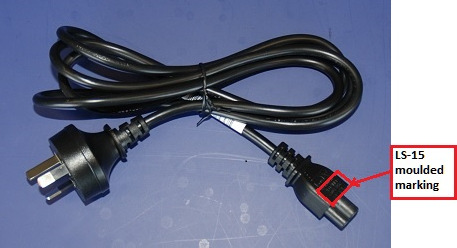
PAULSPIECE COMMENT: the “cordsets” mentioned above are mains power cord set assemblies comprising a mains plug, flexible electrical cord and an appliance connector. Refer to the first image below (images borrowed from the recall notices). All three components individually are Level 3 articles, requiring individual electrical authority approval and EESS registration at Level 3. However the fully-assembled cord set itself is Level 1. There have been three safety-related recalls of the affected IEC 60320 type C5 appliance connector model LS-15 in Australia in recent months from different suppliers (refer to earlier separate posts in paulspiece.com).
Cord set with LS-15 connector indicated on the bottom rightView of the LS-15 appliance connector, on the end of the cord sets, which is subject to these recalls
Product description “LS-15” labeled AC Power cables.
The exposure is limited to a single part number (p/n 145000589) for Australia, New Zealand and Fiji. A sticker attached to the cord with the name Linetek on it will show a revision date ‘REV-001005’. The female connector has the imprint ‘LS-15 Linetek’
What are the defects? In some instances the “LS-15” labelled connector’s electrical insulation may degrade over time with the potential to overheat and burn.
This GU10 LED spot light is cheap (£3 including postage) and bright. But it’s also lethal! There’s a 50% chance of putting live mains within a few microns of the metal casing (which is what you’ll be holding when you insert it) and there’s no earth to protect you. It’s like playing Russian Roulette with 240v AC mains. This sort of thing gives new technology a bad name. Avoid it if you want to stay alive.
Product description “LS-15” labelled AC Power cord sold with PC computers between September 2010 and June 2012
Identifying features “LS-15” moulded marking on appliance connector together with Product code/serial number combination
What are the defects? In some instances the “LS-15” labelled connector’s electrical insulation may degrade over time with the potential to overheat and burn.
What are the hazards? AC Power cord may overheat and potentially cause a burn hazard.
AUSTRALIAN users of some HP and Compaq computers are being urged to return their AC power cords, following a massive recall of 5.6 million cords in the US.Another 446,700 of the Hewlett-Packard LS-15 cords have been recalled in Canada.The recalls are due to concern about overheating, which can pose a fire and burns risk.“Australia is one of the markets impacted by this product recall,” an HP Australia spokesman confirmed to The Australian today.
AC Power Cord set with IEC 60320-1 C5 type Appliance connector. Supplied with HP & Compaq Notebook and Mini notebooks PCs and accessories such as docking stations.
Identifying features
Model “LS-15” moulded marking on Appliance connector
What are the defects?
In some instances the ‘LS-15’ connector’s electrical insulation may degrade over time with the potential to overheat, posing a fire and burn hazard.
What are the hazards?
The AC power cord Appliance connectors have the potential to overheat, posing a fire and burn hazard
She bought the knock-off charger for $10 from Paddy’s Markets as a gift for her son Daniel on his 14th birthday last Sunday but, by Monday evening, the device was a blackened wreck.
Ms Sommerville, from Kanahooka near Wollongong, said she heard a loud bang – ‘‘like metal hitting metal’’ – and saw a flash of light coming from Daniel’s room.
‘‘Daniel came out of his bedroom with a stunned look on his face. He said, ‘the charger’,’’ Ms Sommerville said.
‘‘The whole house smelt like gun powder. I was shocked.’’
The explosion caused the electricity supply to short circuit in three bedrooms, and at one of the loungeroom power points.
‘‘Who knows what would have happened if we didn’t have a circuit breaker,’’ Ms Sommerville said.
‘‘After hearing about the other woman that got killed by it, we’re really thinking how seriously lucky Daniel is.’’
Authorities are warning consumers against buying rip-off USB-style chargers after a young woman wearing headphones and holding her laptop was found dead with burns on her ears and chest, in an apparent electrocution.
The woman’s death is under investigation by police, and Fair Trading was unable to release any further details….
she was found with a lap top and headphones in her ears.”[She had] burns on both ears and her chest,”…
the rip-off, cheap chargers were low quality plastic that could melt.
The devices found by Fair Trading had no insulation on (mains) pins or approval marks.
Consumers who have already bought unapproved and non-compliant USB-style chargers, used to charge phones and tablets, are advised to bend the pins on the chargers and throw them away immediately.
People should also not use any electrical devices while they are plugged in and charging.
The requirements for assessing the competence of electrical work safety observers to rescue and resuscitate a person changed on 1 January 2014.
The person acting as a safety observer for electrical work must be competent to implement control measures in an emergency and be competent to rescue and resuscitate the worker who is carrying out the electrical work. As well, they must have been assessed as competent to rescue and resuscitate a person in the past year (previously six months). This also means that if a person undertakes rescue and resuscitation training and is assessed as competent, they can act as a safety observer for one year without further assessment of their competence.



 paulspiece.com
You must be logged in to post a comment.