When lithium-ion batteries overheat, they can burn through internal pockets, burst into flames, and even explode. One reason such damage can occur is the formation of dendrites—finger-like deposits of lithium that can grow long enough to pierce the barrier between a lithium-ion battery’s halves and cause it to short out.
Dendrites form when a battery electrode degrades and metal ions deposit onto the electrode’s surface. …
In their latest work, Stanford researchers used chemicals designed to prevent dendrite formation.
Not to be confused with the Nobel Prizes, the Ig Nobel Prizes are intended to “honor achievements that first make people laugh and then make them think.” – see the article in the link:
Carbon nanotubes are the leading candidate to replace silicon in semiconductor chips after the decades-long run of silicon electronics runs out. And IBM is hoping to usher along that transition with a new breakthrough being announced today. In the October 2 issue of the journal Science, IBM researchers say they have overcome one of the most daunting challenges around carbon nanotube transistors, which are the building blocks of electronic circuits with dimensions that are measured in billionths of a meter. Carbon nanotube chips could greatly improve the capabilities of high-performance computers, enabling Big Data to be analyzed faster, increasing the power and battery life of mobile devices and the Internet of Things, and allowing cloud data centers to deliver services more efficiently and economically, IBM said.
Researchers at MIT and Samsung, and in California and Maryland, have developed a new approach to one of the three basic components of batteries, the electrolyte. The new findings are based on the idea that a solid electrolyte, rather than the liquid used in today’s most common rechargeables, could greatly improve both device lifetime and safety — while providing a significant boost in the amount of power stored in a given space.
Typically a liquid organic solvent whose function is to transport charged particles from one of a battery’s two electrodes to the other during charging and discharging — has been responsible for the overheating and fires that, for example, resulted in a temporary grounding of all of Boeing’s 787 Dreamliner jets …
““All of the fires you’ve seen, with Boeing, Tesla, and others, they are all electrolyte fires. The lithium itself is not flammable in the state it’s in in these batteries. [With a solid electrolyte] there’s no safety problem — you could throw it against the wall, drive a nail through it — there’s nothing there to burn.”
Some models of (imported) LED light globes cause interference to TV signals. This interference may consist of a sudden loss of signal or picture quality in a residence or neighbouring house. In these cases, the ACMA needs to be able to quickly contact the supplier of the globes to notify them of the problem. People experiencing TV reception problems may also wish to contact the supplier to arrange an exchange or refund.
The consequences of supplying a device that does not comply with Australian law can be serious and may risk your business’s reputation. Taking some simple steps before making a bulk purchase of LED globes (or any electronic device) directly from overseas will help prevent interference.
A battery can catch fire due to an internal short circuit. When a short circuit occurs, it causes overheating of the cells within a battery, which can ultimately lead to a condition known as “thermal runaway”, which doesn’t typically confine itself to just one cell. Increasing pressure and temperature within a cell can cause it to explode and vent its contents. This can lead to neighboring cells going into thermal runaway as well.
Lithium fires are unique in that they are not typically extinguished in the same manner as ordinary combustible fires. Depending on the type of battery, non-traditional extinguishing agents, such as halotron or copper powder, may be needed. A lithium metal fire is treated differently from a lithium-ion fire in that each requires different firefighting agents.
This presentation was written by Paul W Robinson, Australia, and presented to the IEEE Symposium on Product Compliance Engineering (ISPCE) in Chicago in May 2015. It covers the identification of risks to children associated with the use of button or coin batteries or cells, the prevalence and severity of harm to children worldwide, and what can be done to mitigate the severity and frequency of injuries. An author’s copy of the PDF version of the submitted presentation is available at the link.
Sourcing safe products is a responsibility that all suppliers must meet. This webinar is aimed at businesses that supply products within the Australian marketplace and want more information on their responsibilities when sourcing products for their consumers.
There are many prank phone calls that can be considered criminal offences: Threatening to kill or cause serious harm to someone – and not just the person on the phone; Making a hoax bomb threat is a crime; Making prank calls to 000 pretending there is an emergency is open to jail time of up to three years. Even if the prankster doesn’t threaten their victim, repeated calls can amount to harassment, stalking or bullying. Under the Criminal Code it is illegal to use “a carriage service” (that includes phones, emails, texts and social media) to menace, harass or be offensive – with a penalty of up to three years jail.
Silicon and gallium arsenide both begin their progression from raw crystal to electronic device similarly. Both materials are fashioned into what electronics manufacturers call wafers. These are flat, circular platters of purified material. Subsequent manufacturing steps create computer chips, solar cells or other electronic devices on top of these wafers. But it can cost about $5000 to make a wafer of gallium arsenide 8″ in diameter, versus $5 for a silicon wafer … The new Stanford process seeks to lessen this thousand-to-one cost differential by re-using that $5000 wafer.
Office rules issued by a Sydney Law firm in 1852. Fortunately for all concerned, legal workplace have become slightly more informal in the intervening 162 years.
Rules for the Clerical Staff
I like #7: “The calls of nature are permitted, and the Clerical Staff may use the garden below the second gate.”
Online registration for the 2015 IEEE Symposium on Product Compliance Engineering (ISPCE) is now open. We invite you to see the sites of Chicago, engage in the 3 full day technical program, and view the packed exhibit hall on May 18-20, 2015.
It covers papers, presentations, workshops and tutorials on all aspects of product safety and compliance engineering. Link to main site: http://psessymposium.org/
(Public information, copied from an email circular from ERAC Secretariat)
IMPORTANT INFORMATION FOR SUPPLIERS OF CORDSETS
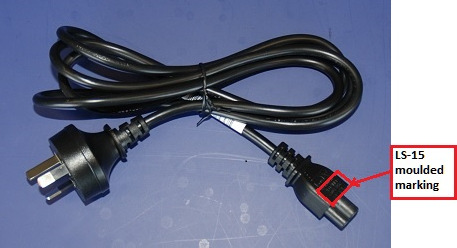
Recently several companies have recalled a C5 type Appliance connector part of a cordset (Australian plug, cord and appliance connector for connection to equipment) that was supplied with equipment. It is reported the fault identified may cause the appliance connector to overheat and cause a fire or burn hazard.
The appliance connector is marked LS-15 and LINE TEK and SAI TE4211EA.
Cordsets are level 1 equipment in the EESS. Responsible suppliers supplying cordsets, either separately or with their electrical equipment, are required to ensure the cordset parts (plug, cord, appliance connector) have current valid certification and are electrically safe.
If you supply cordsets, either separately or with your electrical equipment, you are requested to check if the cordset appliance connector has these markings, and if so then you need to confirm your appliance connector does not have the same fault and is electrically safe. NOTE: it is understood not all appliance connectors of this manufacturer or certification will have this fault.
ERAC secretariat.
PAULSPIECE COMMENT: the “cordsets” mentioned above are mains power cord set assemblies comprising a mains plug, flexible electrical cord and an appliance connector. Refer to the first image below (images borrowed from the recall notices). All three components individually are Level 3 articles, requiring individual electrical authority approval and EESS registration at Level 3. However the fully-assembled cord set itself is Level 1. There have been three safety-related recalls of the affected IEC 60320 type C5 appliance connector model LS-15 in Australia in recent months from different suppliers (refer to earlier separate posts in paulspiece.com).
Cord set with LS-15 connector indicated on the bottom rightView of the LS-15 appliance connector, on the end of the cord sets, which is subject to these recalls

 paulspiece.com
You must be logged in to post a comment.