Online registration for the 2015 IEEE Symposium on Product Compliance Engineering (ISPCE) is now open. We invite you to see the sites of Chicago, engage in the 3 full day technical program, and view the packed exhibit hall on May 18-20, 2015.
It covers papers, presentations, workshops and tutorials on all aspects of product safety and compliance engineering. Link to main site: http://psessymposium.org/
(Public information, copied from an email circular from ERAC Secretariat)
IMPORTANT INFORMATION FOR SUPPLIERS OF CORDSETS
Recently several companies have recalled a C5 type Appliance connector part of a cordset (Australian plug, cord and appliance connector for connection to equipment) that was supplied with equipment. It is reported the fault identified may cause the appliance connector to overheat and cause a fire or burn hazard.
The appliance connector is marked LS-15 and LINE TEK and SAI TE4211EA.
Cordsets are level 1 equipment in the EESS. Responsible suppliers supplying cordsets, either separately or with their electrical equipment, are required to ensure the cordset parts (plug, cord, appliance connector) have current valid certification and are electrically safe.
If you supply cordsets, either separately or with your electrical equipment, you are requested to check if the cordset appliance connector has these markings, and if so then you need to confirm your appliance connector does not have the same fault and is electrically safe. NOTE: it is understood not all appliance connectors of this manufacturer or certification will have this fault.
ERAC secretariat.
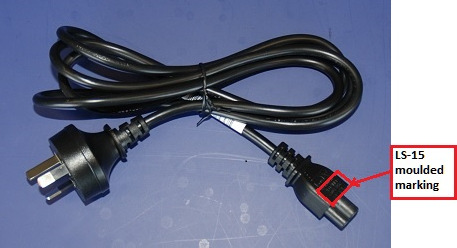
PAULSPIECE COMMENT: the “cordsets” mentioned above are mains power cord set assemblies comprising a mains plug, flexible electrical cord and an appliance connector. Refer to the first image below (images borrowed from the recall notices). All three components individually are Level 3 articles, requiring individual electrical authority approval and EESS registration at Level 3. However the fully-assembled cord set itself is Level 1. There have been three safety-related recalls of the affected IEC 60320 type C5 appliance connector model LS-15 in Australia in recent months from different suppliers (refer to earlier separate posts in paulspiece.com).
Cord set with LS-15 connector indicated on the bottom rightView of the LS-15 appliance connector, on the end of the cord sets, which is subject to these recalls
Product description “LS-15” labeled AC Power cables.
The exposure is limited to a single part number (p/n 145000589) for Australia, New Zealand and Fiji. A sticker attached to the cord with the name Linetek on it will show a revision date ‘REV-001005’. The female connector has the imprint ‘LS-15 Linetek’
What are the defects? In some instances the “LS-15” labelled connector’s electrical insulation may degrade over time with the potential to overheat and burn.
The Australian Garage Door Association AGDA is lobbying government … to enforce full mandatory compliance to Australian and New Zealand ANZ standards for all parties involved in this area of (garage doors) construction. “.. it is in fact the responsibility of the installers, builders and designers of buildings to ensure compliance in relation to garage doors, not just manufacturers,” said Fraser.
In addition to lobbying the government for non-compliance, the AGDA is calling for additional safety mechanisms in automated garage doors to be made mandatory. They also want to enforce secondary entrapment protection for automatically operated garage doors under ANZ regulations
Product description “LS-15” labelled AC Power cord sold with PC computers between September 2010 and June 2012
Identifying features “LS-15” moulded marking on appliance connector together with Product code/serial number combination
What are the defects? In some instances the “LS-15” labelled connector’s electrical insulation may degrade over time with the potential to overheat and burn.
What are the hazards? AC Power cord may overheat and potentially cause a burn hazard.
Tectron International has issued a recall for approximately 55,000 USB chargers because the chargers can overheat while in use, posing a fire hazard. The 3-in-1 chargers feature a 10-foot white cord with a USB plug on one end and 30-pin plug, lightning plug, and a mini USB plug on the other end. The chargers are compatible with different models iPhone, iPads, and android phones. The chargers were sold during school fundraisers from July 2014 to August 2014.
The ACCC has published guidance on safe concentrations of particular chemicals in consumer goods. The guidance prescribes concentrations of chemicals, below which a safety concern does not exist. It includes a list of 22 hazardous aromatic amines which can be derived from certain hazardous azo dyes in clothing, textiles and leather articles. Guidance is also provided for safe concentrations of formaldehyde in clothing and textiles.
AUSTRALIAN users of some HP and Compaq computers are being urged to return their AC power cords, following a massive recall of 5.6 million cords in the US.Another 446,700 of the Hewlett-Packard LS-15 cords have been recalled in Canada.The recalls are due to concern about overheating, which can pose a fire and burns risk.“Australia is one of the markets impacted by this product recall,” an HP Australia spokesman confirmed to The Australian today.
AC Power Cord set with IEC 60320-1 C5 type Appliance connector. Supplied with HP & Compaq Notebook and Mini notebooks PCs and accessories such as docking stations.
Identifying features
Model “LS-15” moulded marking on Appliance connector
What are the defects?
In some instances the ‘LS-15’ connector’s electrical insulation may degrade over time with the potential to overheat, posing a fire and burn hazard.
What are the hazards?
The AC power cord Appliance connectors have the potential to overheat, posing a fire and burn hazard
Lithium batteries pose a unique hazard during transport because they contain stored energy, which if released through a short circuit is capable of causing a fire.
She bought the knock-off charger for $10 from Paddy’s Markets as a gift for her son Daniel on his 14th birthday last Sunday but, by Monday evening, the device was a blackened wreck.
Ms Sommerville, from Kanahooka near Wollongong, said she heard a loud bang – ‘‘like metal hitting metal’’ – and saw a flash of light coming from Daniel’s room.
‘‘Daniel came out of his bedroom with a stunned look on his face. He said, ‘the charger’,’’ Ms Sommerville said.
‘‘The whole house smelt like gun powder. I was shocked.’’
The explosion caused the electricity supply to short circuit in three bedrooms, and at one of the loungeroom power points.
‘‘Who knows what would have happened if we didn’t have a circuit breaker,’’ Ms Sommerville said.
‘‘After hearing about the other woman that got killed by it, we’re really thinking how seriously lucky Daniel is.’’
Note: This article talks of Australian Product Safety laws and regulations, as they relate to the Australian Consumer Law (ACL) so is of general interest. However it doesn’t specifically cover safety of electrical equipment which is mandated under State laws. You can find the Electrical safety regulations information at http://www.erac.gov.au/ for the laws and regulations and regulators which supplement and complement the ACL for electrical safety.
Extract from the news article below:
If you sell products Australian customers, including the sale of products online, you must meet product safety requirements under Australian Consumer Law. If you’re a supplier or manufacturer, you are legally obligated to comply with mandatory Australian safety standards and only market safe products. Mandatory standards are law, and there are penalties and consequences for selling products that do not comply.
Authorities are warning consumers against buying rip-off USB-style chargers after a young woman wearing headphones and holding her laptop was found dead with burns on her ears and chest, in an apparent electrocution.
The woman’s death is under investigation by police, and Fair Trading was unable to release any further details….
she was found with a lap top and headphones in her ears.”[She had] burns on both ears and her chest,”…
the rip-off, cheap chargers were low quality plastic that could melt.
The devices found by Fair Trading had no insulation on (mains) pins or approval marks.
Consumers who have already bought unapproved and non-compliant USB-style chargers, used to charge phones and tablets, are advised to bend the pins on the chargers and throw them away immediately.
People should also not use any electrical devices while they are plugged in and charging.
“Google recently reported that its fleet of self-driving cars has traveled a combined 700 000 miles without human assistance. That’s way more experience than you or I had before we got behind the wheel for our road tests. So it stands to reason that autobahn automatons will soon be granted driving privileges. But the licenses California says it plans to issue to robots will be the equivalent of learner’s permits—that is, a digital driver must be under the watchful supervision of a licensed and insured human driver”

 paulspiece.com
You must be logged in to post a comment.